
Doctorate in Bulgaria
Pursue a part-time doctorate at the state university ULSIT in Sofia. KMK equivalent, internationally recognized, achieve your Dr. in 2 to 3 years.
Dr. Awarded Degree
2-3 Years Standard Duration
24,480 € Tuition Fees
The University
ULSIT Sofia, Bulgaria
A state university in the heart of the Bulgarian capital.
The doctoral program is conducted at the University of Library Studies and Information Technologies (ULSIT), a state-recognized university in Sofia, Bulgaria. ULSIT is a fully accredited institution with the right to award doctoral degrees.
As an EU member state, Bulgaria is part of the Bologna Process. All ULSIT degrees are recognized at the European level. The doctorate corresponds to the third Bologna cycle and thus the highest qualification level in the European Qualifications Framework (EQF Level 8).
Overview
Program Details
All key facts about the doctoral program.
Degree Doctoral degree "Dr." (can be used without country of origin designation)
Study Format Part-time distance learning, in-person attendance only for the defense in Sofia
Standard Duration 4 to 6 semesters (2 to 3 years), depending on progress
Start Date Enrollment possible at any time, flexible entry options
Language Dissertation in German or English, supervision available in both languages
Qualification Level Bologna Level 3, EQF/DQR Level 8
Recognition KMK equivalent, recognized across the EU, entry in identity documents possible
Official Recognition
KMK Equivalence
Recognition by the German Standing Conference of Ministers of Education.
The ULSIT doctoral degree in Sofia is considered equivalent to a German doctorate according to the Standing Conference of the Ministers of Education and Cultural Affairs (KMK). This means: the "Dr." title can be used in Germany without a country of origin designation and without a subject-specific suffix. It is fully equivalent to German doctoral degrees.
The following documents confirm the official equivalence. The documents are pixelated for privacy reasons. The original equivalence certificates can be viewed upon serious interest and concrete inquiry.
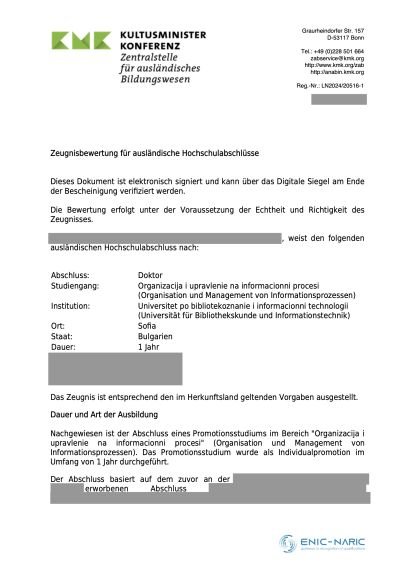
Equivalence Certificate (Page 1)
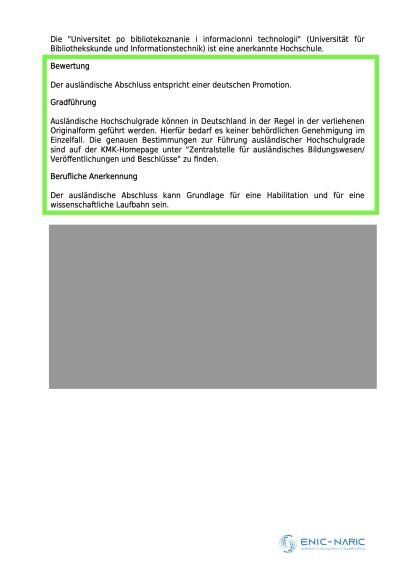
Equivalence Certificate (Page 2)
Important: The KMK evaluates each case individually and may also review prior studies (bachelor/master) in detail before issuing an equivalence certificate. Recognition may therefore vary for each applicant.
Investment
Doctoral Program Costs
Transparent cost breakdown.
Tuition Fees 24,480 €
Additional Costs (approx.) 2,388 €
Total Investment approx. 26,868 €
Expect approximately 10% in additional costs. These include costs for publications, translations, travel to the defense, accommodation, and possibly certifications.
Target Audience
Who Is This Program For?
Working academics who want to earn their doctorate efficiently.
Working Academics
Those who want to earn their doctorate efficiently in 2 to 3 years without giving up their career.
Maximum Flexibility
Free time management, flexible structure, everything via distance learning until the defense.
Building on Prior Work
The dissertation can build upon existing theses (e.g., master's thesis).
Wide Range of Topics
Hardly any restrictions on topic selection, a broad spectrum is possible.
Requirements
Admission Requirements
Required qualifications for the doctoral program.
Master's Degree
Master's degree from a recognized university or institution of higher education
Master's degree from a recognized university or institution of higher education
or
University Diploma / Magister
With at least eight semesters of standard study duration
With at least eight semesters of standard study duration
or
University of Applied Sciences Diploma
With demonstrated doctoral eligibility
With demonstrated doctoral eligibility
or
First State Examination
With at least eight semesters of standard study duration
With at least eight semesters of standard study duration
Alternative: If you do not meet the admission requirements for ULSIT, two additional state-recognized universities in Malta and Poland are available. Contact me for details
Your Path to the Dr.
Doctoral Program Process
9 steps to your doctoral degree.
1
Doctoral Eligibility Review
Book a free initial consultation via Zoom. Bring your degree documents (master's diploma and diploma supplement) so I can assess your doctoral eligibility without obligation.
Note: For older diplomas or more unusual qualifications, an additional review may be required.
2
Admission to the Doctoral Program
Once doctoral eligibility is confirmed, I coordinate your topic and title with UNIBIT. This is based on a research concept for which I provide a template.
3
Working on the Dissertation Foundations
After developing your research concept, the next step is to create the foundations of your dissertation (approx. 50 pages).
4
Preparing Application Documents
Once you have written the dissertation foundations, you should have your additional documents prepared to successfully move on to Phase 2.
5
Presentation to the Doctoral Committee
The final step of PhD Phase 1 is to present yourself and your motivation for developing your dissertation in a short video.
6
Welcome to Phase 2
After your successful presentation, you are officially admitted to the examination phase. You will also be assigned a supervisor from the university's faculty.
7
Assignments and Completion
In Phase 2, five to six examinations must be completed, three publications (if you cannot yet demonstrate any), and the dissertation foundations must be finalized.
8
Pre-Defense and Final Defense
The pre-defense is an online meeting where UNIBIT professors provide feedback on the research. The professors' recommendations must be incorporated into the dissertation. The final defense takes place in person in Sofia.
9
Graduation
You receive the degree "Doctor," abbreviated "Dr." This title is used in Germany and Austria without a country of origin or subject designation and is entered in public documents and passports as a scientific doctoral degree at Bologna Level 3.
Support
Support During the Program
These services are included in the program.
Academic Consulting
Templates, access to the learning platform, and support via email, phone, or online meetings
Defense Examples
Examples of successful defense presentations for orientation
Publication Support
Assistance with scientific publications in academic journals
Translation Assistance
Support with required translations into Bulgarian
Organizational Support
Guidance around the pre-defense and final defense in Sofia
High Success Rate
Proven program with structured support through to completion
Application
Application and Documents
What you need for the application.
Application for Admission
Signed application for admission to the doctoral program
Signed application for admission to the doctoral program
Proof of Identity
Copy of national ID card or passport
Copy of national ID card or passport
CV (Europass preferred)
With color photo, signature, and social security number
With color photo, signature, and social security number
Copy of Academic Degree
Notarized copy of master's diploma and, if applicable, diploma supplement
Notarized copy of master's diploma and, if applicable, diploma supplement
Dissertation Concept
With a pre-agreed topic, confirmed by the university
With a pre-agreed topic, confirmed by the university
Medical Certificate
Proof of fitness to study
Proof of fitness to study
Publication List
List of scientific publications, if available
List of scientific publications, if available
Application assistance: I help you compile and prepare all application documents. In a personal meeting, we clarify all open questions.
Frequently Asked Questions
FAQ About the Doctoral Program
Frequently asked questions about the doctorate in Bulgaria.
Recognition and Title Usage
What qualification level does the program have?
Doctorate at the third Bologna level, classified at the highest level of the national and European qualifications frameworks.
What degree is awarded and how may it be used?
Upon successful completion, the doctoral degree Dr. is awarded. The degree is recognized in Germany and Europe and can be used without a subject-specific suffix and without a country of origin designation.
Can the degree be entered in identity documents?
Yes. The doctoral degree is a name suffix and can be entered in a national ID card or passport upon request.
Application and Admission
What documents are required?
Application for admission, ID card or passport, Europass CV in English with photo and signature, a notarized copy of the master's diploma, and if available, a notarized copy of the diploma supplement, dissertation concept, medical certificate of fitness to study, publication list if available.
Who is eligible for admission?
Master's degree from a recognized university, alternatively a university diploma or Magister with at least eight semesters, university of applied sciences diploma with doctoral eligibility, or first state examination with at least eight semesters.
How do I submit the documents?
Degree documents as notarized copies by mail, other documents electronically. Individual originals may be additionally requested during the process.
Why are certifications required?
The documents are translated, notarially certified, and legalized for the official review process. This serves formal quality assurance.
Study Start and Duration
When can I start and how long does it take?
Start at any time. Official program duration is three years. Completion in a shorter time is possible, depending on the progress of the dissertation.
Study Plan and Examinations
What does the study plan include?
The first part contains official information: your name, admission date, study duration, scientific field, supervisors, and dissertation title. The second part contains information about all examinations to be completed, form of assessment, etc. Along with the study plan, you receive well-described assignments for each examination.
What examinations are required?
6 written assignments, a brief description of the dissertation (autoreferat), and the dissertation itself. The dissertation is submitted and evaluated in writing. The pre-defense and final defense are also evaluated.
Are there templates and resources?
Yes. Templates, examples, guidelines, and sample examinations are available.
Dissertation
When do I start and in what language do I write the dissertation?
Immediately after admission. The dissertation can be written in German or English. Writing in English or Bulgarian saves later translation costs.
What is the expected length of the dissertation?
Target length is 150 to 180 pages including table of contents and appendices. The Grounds of Dissertation are the first approximately 50 pages with introduction, objectives, and theoretical foundations, serving as a milestone for content fine-tuning.
What belongs in the dissertation concept?
Topic and relevance, research questions and objectives, methodology, structure, target academic audience, and transparency and verifiability.
Dissertation Summary
What is the autoreferat and why is it necessary?
A legally required summary, published one month before the defense on the university website, printed in sufficient copies for the committee. The document is published in the official language of the country, so a translation is required.
Scientific Publications
How many publications are required?
At least three topic-related publications are required for admission to the final defense. They demonstrate your contribution to the scientific community.
Where can I publish and in what language?
In suitable academic journals, edited volumes, or series. Citations are in the original language; translation of the publication is not required.
Public Final Defense
Process and language of the presentation
Introduction by the committee, presentation of the work, reviewers' statements, Q&A session, followed by a vote. Presentation language is typically English, German is possible. A live interpretation service is recommended, as procedural elements take place in the local language.
What costs arise around the defense?
Printing the dissertation in multiple copies and the summary, on-site interpretation, travel, and accommodation.
After the Defense
When do I receive the certificate?
The certificate is issued after formal approval and is usually sent within approximately four weeks. The documents comply with national and EU requirements. Additional nostrification in Germany is not required.
Classification of Degrees
What do Bologna, ECTS, and the degree classification system regulate?
Bologna harmonizes study structures in Europe, ECTS represents the workload, bachelor's and master's degrees lead to the scientific doctorate as the third level.
What are EQF and DQR?
Frameworks for comparing qualifications in eight levels, based on learning outcomes. Bachelor's corresponds to Level 6, master's to Level 7, doctorate to Level 8. The DQR serves an informational function for classification and does not replace specific admission rules.
Use of Foreign Degrees
When can foreign degrees be used in Germany?
When the degree was obtained at an institution recognized in the country of origin. Degrees from EU and EEA countries may be used in their original form without a country of origin designation. Scientific doctoral degrees at the third Bologna level may optionally be used as "Dr."
Next Step
Ready for Your Doctorate?
Let us review your doctoral eligibility in a free initial consultation.